

TUESDAY, SEPTEMBER 29, 2026

Nine Architectural Traditions and the Character They Bring to Our Neighborhoods
By Declan Spring

Recently, while chatting with a potential client about houses in the East Bay, they told me something I hear repeatedly from people looking to purchase property here.
“I want something with character. Something with architectural flair. Something with design qualities that inspire me every day.” Fortunately, our housing stock rarely disappoints in that regard.
On the same day I had that conversation, I turned from the Arlington onto Thousand Oaks Boulevard and drove toward Colusa Avenue. Along that short stretch, I passed examples of nearly every housing style featured in our new Field Guide to East Bay Home Styles. If you don’t believe me, do yourself a favor and walk that route. Look up from the sidewalk and take your time. Study the rooflines, porches, windows and the way each house meets the street. You may also come across homes designed by important local architects, including Julia Morgan and John Hudson Thomas. I should make one confession. I did not actually pass a Mid Century Modern home on that particular stretch. There are some within a few blocks, however, so I feel I was close enough.
It really is remarkable. You can walk through a beautiful Inner East Bay neighborhood and see so many periods of American residential architecture sharing the same streets. You would be hard pressed to recreate this experience in many other parts of the country. That afternoon, I decided it was time to put together a field guide. The guide covers Victorian, Edwardian, American Foursquare, Craftsman, Arts and Crafts, Dutch Colonial Revival, the flat roof stucco homes of the 1920s and 1930s, Tudor Revival and Mid Century Modern architecture.
As a realtor, I also wanted to include some practical guidance. Each style comes from a different era and has its own particular vulnerabilities. The guide points to the roof, drainage, foundation, chimney, exterior and structural details that deserve attention. It also considers how older homes compare with newer construction when it comes to kitchens, closets and everyday living space.
This helps explain why property value can be difficult to understand in the East Bay. Every house has to be considered on its own merits. Architectural style is only the beginning. We also look at location, light, floor plan, hillside conditions, seismic improvements and the maintenance decisions made by successive owners.
Two houses built in the same year, on the same street and in the same style can have very different values because their histories have unfolded differently. That individuality is part of what makes Inner East Bay real estate so interesting.
The field guide is meant to be a short and enjoyable introduction to this extraordinary housing landscape. It is also an encouragement to get outside and look around. Take a walk from Great Stoneface Park to John Hinkel Park. Keep your head up and notice how the houses change from one block to the next. A few years ago, I published ‘Tilden’, a small book of photographs from Tilden Regional Park. I made it for much the same reason. I wanted to remind people of what we have right here in our backyard and how much joy and inspiration can come from a simple local walk.
You can now find the Field Guide to East Bay Home Styles under the Resources tab on The Home Factor website. I have added a few other useful and interesting items there as well. Take a look and see what you find. If you enjoy the guide, please consider sharing this newsletter, our website and our contact information with someone who may be thinking about a move, either now or sometime in the future. We would be honored to help. We care deeply about the people we serve and the remarkable place we are fortunate enough to call home.
The Home Factor. The East Bay real estate team people keep. 👉 Take a look at the refreshed website!
THE STATE OF THE MARKET
The Housing Factor
By Ehsan Habib

REND REVERSAL! THE AUGUST THAT DARED TO DEFY 2026
This is the first month since November 2025 that we saw more new listings YoY¹. For most months over the past year, we saw less new listings, more sales, and higher prices. This August, the data moved in significant ways.
August 2026 vs 2025 had:
8.6% More Listings (494 vs 455)
11.4% Fewer Listings Sold (311 vs 351)
16% Higher Median Sold Price
8.6% Higher Median List Price
14.5% Higher Avg Sold Price
7.6% Higher Avg List Price
The median home sold for 13% over its list price, compared with 6% over list price last year. Homes also sold more quickly. In August 2026, the average time on the market was 24 days and the median was 15 days. In August 2025, the average was 33 days and the median was 19 days.
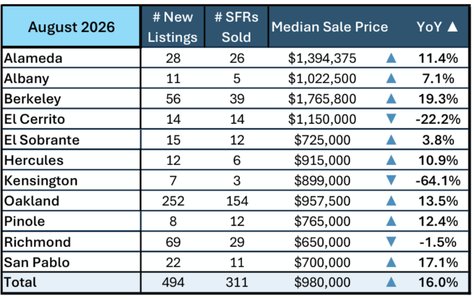
*Data is sourced from the MLS and considers detached Single-Family Homes (both charts)
At first glance, higher prices and faster sales suggest that the market is clearly hotter than it was last August. The 16% year over year increase in the median sale price, together with the faster median sale, certainly shows the strength of the market. However, these figures do not mean that every seller is benefiting equally. Attractive homes that are priced and marketed well are selling quickly and for strong prices. Buyers are much less willing to settle for homes that are overpriced or poorly presented, and those properties are sitting on the market.
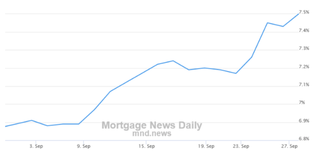
The absorption rate, which measures how quickly available inventory is being purchased, normally declines at the end of summer. This month, however, it fell more sharply than it has during the same period in recent years, dropping from 61% to 49%. This may simply be a normal adjustment after a year of rising prices and intense buyer competition. Even so, there is reason to believe the next few months could be difficult for many sellers. Mortgage rates have risen sharply almost out of nowhere over the past week, to 7.5%, and it will take some time before the market data fully reflects the effect on buyers. The Inner East Bay currently has a greater supply of homes than at any point so far in the second half of the year, and we’re going into an especially consequential election season, an environment that historically has cooled the real estate market.
If you would like a closer look at the cities and neighborhoods that you are most interested in - or for our opinion on how we’re seeing the market shape up on the ground - reach out to the friendly Home Factor™️ Realtor of your choice. We’re always happy to hear from you.
You can email me directly at Ehsan@TheHomeFactor.com
¹ Year-over-year
Interest rate chart courtesy of Mortgage News Daily
Mortgage news
MORTGAGE MUSINGS
By Evelyn Freitas | VP of Mortgage Lending at Guaranteed Rate NMLS 247578

Mortgage Musings – Wanting and Waiting
You see a jacket you love, and you buy it. Your friends invite you to dinner at a restaurant, so you go. Your car is giving out, so you pick the one that feels right at the price on the sticker. Nobody circles the mall for two years waiting for that jacket to hit its lowest price in a decade. So what is it about buying a home that flips the script? It's the most important purchase most of us make, and yet plenty of buyers wait for a lower rate, when everything else in life is decided by how much they want it.
The rate story
Freddie Mac's 30-year average reached 7.03% on September 24, up from 6.23% in April. Hot inflation readings and the ongoing Iran war are keeping prices elevated across the economy. That stings if you're shopping for a home.
Waiting for a drop rests on a guess: that rates will fall, soon, and far enough to matter. Nobody can promise that when rates are driven by geopolitical and economic forces beyond anyone's control. In February, the average touched 5.98%, its lowest point in three and a half years. Buyers holding out for even lower are now looking at 7%.
The number on your check
Think about this – your mortgage rate doesn't appear anywhere on the check you write every month. Only the payment does. So the real question is whether that payment fits comfortably in your budget. If it does, today's rate can be the right rate for you.
Prices haven't waited either. For instance, the California Association of Realtors reports a Contra Costa County median of $875,000 in August, up 2.9% from $850,000 a year ago, through a stretch that included the lowest rates in over three years. Lower rates didn't slow prices down. They kept climbing.
Here's the payment math. A year ago, at $850,000 and 6.30%, principal and interest with 20% down ran about $4,209 a month. Today, at $875,000 and 7.03%, it's about $4,671. That's $462 more a month for a buyer who waited for a better rate. (Principal and interest calculated on median prices; yours will vary.)
Homes are still moving
Supply across California sits at 3.7 months for single-family homes, below the 3.9 months of a year ago and well short of the six months typically seen in a balanced market. Contra Costa homes sold in a median of 20 days in August. Whenever rates dip, waiting buyers will likely return en masse, and more buyers can mean more competition.
Buying now also lets you start building equity today, and if rates ease later, refinancing can lower your payment. If the payment fits your life, now may be the right time to stop waiting.
Let's talk about what you want
Are you waiting on a rate, or a home that feels right? Email me at evelyn.freitas@rate.com, and I'll show you payment options at today's rates and help you build a plan around your family and financial goals. A quick conversation can save you time, money, and stress.
Sources: Freddie Mac Primary Mortgage Market Survey (September 24, 2026); California Association of Realtors August 2026 Sales and Price Report; HousingWire, "Continued Iran conflict raises mortgage rate risk into late 2026."
Evelyn Freitas, NMLS #247578, Guaranteed Rate Inc, NMLS #2611

substack: why our monthly newsletter isn’t enough
By Declan Spring
Think you’re “in the know” from our monthly recap? Think again. Real estate markets move fast, and a once-a-month snapshot can’t keep up.
That’s where our Weekly Substack comes in — it’s your early-warning system, unpacking fresh inventory data, interest-rate shifts, neighborhood trends, and hidden opportunities well before the headlines catch up.
Every issue delivers:
Local open-house & listing insights
Real-time rate analysis
Tactical tips for buyers, sellers, and refinancers
Market signals you won’t see anywhere else
Make your decisions with confidence — not hindsight.
Click here to subscribe to our weekly Substack now and stay one step ahead.

THE HOME FACTOR ON YOUTUBE!
Our YouTube channel offers short, real-world videos showing how we transform and market the older homes we represent. Subscribe—and feel free to share it with anyone considering a sale who wants to see how we guide older homes into newer hands.
Click here to subscribe to our YouTube Channel for some behind the scenes magic.

We are The Home Factor, REALTORS®, serving clients in the San Francisco Bay Area, and beyond.
THE REAL ESTATE TEAM YOU KEEP
Everyone Can Search. Our Clients Have Someone to Call
Declan Spring · Declan@thehomefactor.com · (415) 446-8591 · DRE#01398898
Denitsa Shopova · Denitsa@thehomefactor.com · (510) 220-1634 · DRE#02137852
Ehsan Habib · Ehsan@thehomefactor.com · (510) 730-4516 · DRE#02166899
Matt Szemela · Matt@thehomefactor.com · (646) 528-5783 · DRE#02241673
Becca Wilcox · Becca@thehomefactor.com · (510) 996-8747 · DRE#02241574
The Home Factor • DRE#01398898 • Powered by Keller Willams • 2089 Rose St, Berkeley, CA 94709 • Declan@TheHomeFactor.com · (415) 446-8591